Category: Particle Contamination
Jim Fitch authored articles & papers
-
An Introduction to Fluid Contamination Analysis
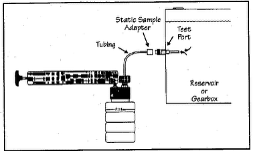
Oil contamination may be defined as any foreign material found in the lubricant which is not added by design. Usually, contaminants are not beneficial, and may be detrimental, to the performance of the oil and/or the operating machinery. Read More
-
Clean Oil Reduces Engine Fuel Consumption
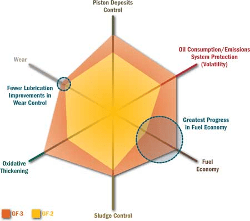
When a lubricant degrades, it forms reaction products that become insoluble and corrosive. So too, the original properties of lubricity and dispersancy can become impaired as the lubricant ages and additives deplete. Read More
-
Particle Contamination — Both a Cause and a Result of Mechanical Failure
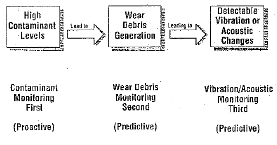
The monitoring of particle contamination in lubricating fluids is a critical indicator of incipient and impending failures. Recent research, under both laboratory and field conditions of the contaminant sensitivity of bearings, reveals a well defined cause and effect relationship between contaminant levels and relative machine life. Read More
-
What Do You Do with a High Particle Count?
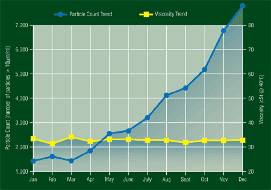
In recent years, I’ve been part of numerous investigations relating to expensive machine failures preceded by oil samples that registered high particle counts. Each time I asked the asset owner, my client, why the aberrant particle trends were not investigated further. In most cases the response was that they didn’t think it merited the extra… Read More
-
Why Onsite Particle Counting Makes Sense

With the widespread use of plant-level particle counters, maintenance organizations are becoming more sophisticated and skilled in the management and control of oil cleanliness. This has led to the discovery of a host of new tactics and practices that involve combining the particle counter with other important onsite oil analysis tools and methods. Read More
-
Comparison of Particle Counts Between Eight Commercial Oil Analysis Laboratories

The inclusion of particle counting in the periodic analysis of hydraulic and lubricating fluids has provided an important new advancement to machine diagnostics. With particle counting, machinery users can monitor the principal cause of failure, not just the symptoms, or results, of failure. The benefit, when particle levels are controlled, is extended machine life and… Read More
-
Diesel Engine Oil Particle Counting Methods
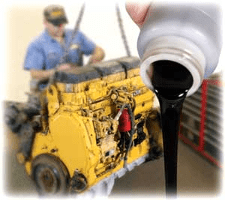
In condition monitoring, any property that is important to machine reliability and life extension should be a property that is measured, assuming it is technically and economically feasible. Read More
-
Interpreting Contaminant Analysis Trends into a Proactive and Predictive Maintenance Strategy

Condition monitoring can be easily performed by following a few simple principles. Among these principles include monitoring two sets of conditions. Read More
-
Particle Contamination – 10 Important Things You Should Know
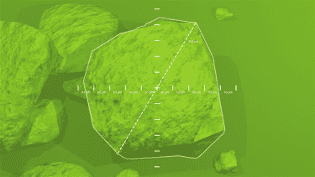
This isn’t your usual article on how important clean oil is to lubricant health and machine reliability. Yes, we are going to talk about particle contamination, but we’re going to take a much closer look at the destructive traits of this nearly invisible material that cohabitates with our lubricants. Read More
-
Recognizing the Causes and Hazards of Silt Lock
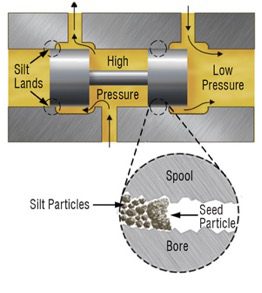
Do you know about silt lock? This common condition causes motion impediment failure in certain machines. While this type of failure usually doesn’t involve wear or permanent internal damage to the machine, it is sudden and abrupt. Read More
-
What is the No. 1 Cause and the No. 1 Consequence of Wear?
Particles. Think about it. Tribological studies on wear-related machine failure rank particle-induced abrasion as the No. 1 cause of wear. Read More
-
Ghost Riders That Haunt Your Oil

The definition of a contaminant is any foreign “something” that enters a lubricant during formulation, packaging, transport, storage or service. Contaminants compromise the lubricant’s integrity, performance and service life as well as impart harm to the machine. Read More
-
How Dirt can Contaminate a Lubricant

Do you really know how your lubricants become contaminated? Have you taken an inventory of the sources of contamination and the primary points of entry? If not, you are in the majority as sadly, few organizations go to the trouble of performing a contaminant ingression study. Read More
-
Take Particle Settling and Oil Sample Agitation Seriously

When you throw a rock in a lake, it goes down – fast. Wear particles are heavier than rocks of the same size, often four to five times heavier. Of course, the heavier the object, the faster it falls. Oil is viscous, and this resistance can slow down the rate objects fall, but it doesn’t… Read More
-
The Power of the Patch. Comparing Particle Analysis Methods

The practice of transferring suspended particles to the surface of a membrane for analysis has been around for decades. It is perhaps the earliest method for inspecting solid contaminants and wear debris in a used sample of oil. Read More
-
Looking Through the Eyes of Onsite Contaminant Monitors
Without the lens of a microscope, bacteria and viruses might only be recognized as painful symptoms of sickness and disease by those who are infected. Just as technology is an important enabler in human pathology, it also serves in the detection and diagnosis of a host of machine health issues, including the invasion of lubricant… Read More
-
Particle Counting – Deploying the Invisible Filter
This past year Practicing Oil Analysis featured many end-user case studies documenting cost savings from oil analysis. Surprisingly, the majority of these studies describe the partnering of oil analysis with contamination control*. Read More
-
Proactive maintenance targets extending machine life
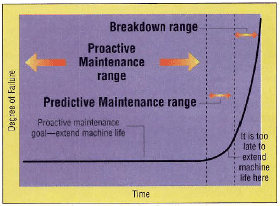
Equipment maintenance costs represent an unclaimed gold mine of savings opportunities. Yet deep maintenance cost reductions have evaded the efforts of even the most diligent and sophisticated operations. Why? Because there has been a general lack of emphasis on maintenance that corrects root causes, as opposed to responding to the symptoms or results of failure. Read More