By Jim Fitch
Machinery Lubrication Training
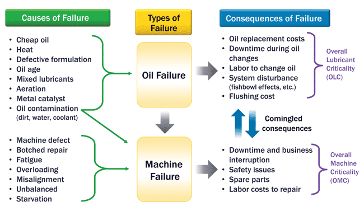
It is intuitively obvious that smart maintenance decisions require a heightened sense of both the probability and consequences of machine failure.
However, when lubricants fail, there are consequences that are, at least initially, independent of machine failure. These include the lubricant replacement cost (material, labor, flushing, etc.) and associated downtime. These costs can exist in the presence of a perfectly healthy and operating machine.
Of course, lack of timely replacement of a defective lubricant will invariably lead to dire machine failure consequences. For some machines, these cascading events can produce enormous collateral damage and financial hardship to an organization.
In the next issue, I will explain how nearly all decisions related to lubricant analysis and inspection depend on four factors: Overall Machine Criticality, Overall Lubricant Criticality, Machine Failure Modes Effects Analysis (M-FMEA) and Lubricant Failure Modes Effects Analysis (L-FMEA).
For instance, regarding inspections, these factors influence what to inspect, when to inspect and how to inspect. In relation to oil analysis, these factors affect where to sample, how often to sample, which tests to conduct, which alarms to set and the general data-interpretation strategy.