Category: Lubricant Analysis
Jim Fitch authored articles & papers
-
A Well-Constructed Oil Analysis Report
Think of oil analysis as being like the television game show Wheel of Fortune. There’s a message to be told but you’ll only see and understand it if you expose enough letters in their proper order. Read More
-
Hydrocarbon Analysis

The aim of this chapter is to briefly present six analytical methods for characterizing hydrocarbon compounds found in fuels and lubricants. Read More
-
In Search of a Definition – What is Oil Analysis?

The term “oil analysis” has been used with respect to lubrication and machine reliability since the 19th century. Yet, over the years I have seen only a few attempts to assign a specific definition to the activity despite its widespread application in industry. Most of these definitions are too narrow or fail to include important… Read More
-
Listen to Your Lubricant

Arguably, more change has occurred related to lubricant analysis and condition monitoring in the past 30 years than all other areas of lubrication. Why does this make sense? The wisest among us know that relentless measurement is a key enabler to forward progress and change. Measurement leads us to awareness and finally to action (tangible… Read More
-
Oil Analysis Reports – What’s Missing in the Comments?

It is often said that a well-engineered oil analysis program has three essential categories. In the past, I’ve referred to this as the iron triangle of oil analysis. The three categories are: Read More
-
Standby Equipment Oil Monitoring and Maintenance

Many lubricants residing in standby equipment have only a few hours of service life. These few hours may be only from occasional scheduled restarts, typically circulating the oil at low load, sometimes barely warming it to operating temperature. In other cases, standby, laid-up and peak-load equipment may sit for weeks or even months without use. Read More
-
The Surface Tension Test – Is It Worth Resurrecting?

In all of my years in oil analysis, I cannot recall a single time when data from a surface tension (ST) or interfacial tension test (IFT) appeared on a routine analytical report, aside from transformer oil analysis, for which the test is considered routine. Read More
-
Using ‘Unscheduled’ Oil Analysis for Early Predictive Maintenance
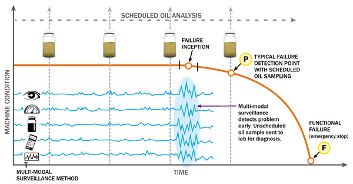
Most oil samples are taken based on a fixed schedule. For large, stationary rotating equipment, monthly or bi-monthly samples are common. Proactive maintenance programs depend on regular checks for oil cleanliness, dryness and lubricant quality. Read More
-
Which Questions Does Your Oil Analysis Program Answer?

Is the cost of oil analysis really justified? Perhaps you’ve heard another rhetorical question. How long is a piece of string? The answer to both questions is the same – it depends. Oil analysis is justified only when the answers to specific questions about the oil and machine have sufficient value to offset the cost.… Read More
-
How to Optimize the Effectiveness of Oil Analysis

Recently, I heard someone say that for sixty percent of heart failures, the No.1 symptom was death. Although this is an interesting and serious statistic, one has to acknowledge the possibility that certain symptoms were ignored or simply went unnoticed. Read More
-
Oil Analysis Effectively Uncovers Hidden Problems
Oil analysis is about surfacing problems that were otherwise hidden from view. We’ve all heard the phrase “if it ain’t broke don’t fix it,” but an important corollary is “if it is broke, fix it fast.” The basic problem with this strategy is not knowing when something is actually broken. Read More
-
Oil Analysis—Choose Your Weapon
A number of months ago I was invited to participate in a planning meeting for re-engineering oil analysis at a large industrial plant. Shortly after taking my seat, introductory remarks were made by the superintendent of maintenance to set the stage for the work ahead. To my surprise we were told to develop a strategy… Read More
-
Using Oil Analysis to Monitor the Depletion of Defoamant Additives

The defoamant (also known as antifoam agents and foam inhibitors) is a common additive in many types of lubricating oils and hydraulic fluids. As the name implies, the purpose of the defoamant is to retard the formation of stable foam on the surface of the oil in the sump, gearbox, or reservoir. Read More
-
Five Essential Lube Oil Properties Not Routinely Reported by Your Oil Lab
You may be surprised to learn that there are no less than five lubrication performance properties that are missing from nearly all in-service oil analysis reports. These are not esoteric properties that are of limited value or interest to those in charge of machine reliability. Instead, they represent the core foundation of a lubricant’s formulation… Read More
-
Is Your Oil Analysis Program a Quart Low?

Not long ago I read a magazine article on predictive maintenance that referred to oil analysis as a means to “time” an oil change. Sadly, no other application or benefit was mentioned. The author was obviously trying to give credit to the field but unknowingly diminished its importance and value. An opportunity was lost. Read More
-
Oil Analysis and the Lean Organization

Like people, organizations have their defining moments– points in time when old notions and business paradigms must be cast aside. Indeed, as we cross into the new millenium, such transformations are permeating nearly all business sectors. Read More
-
Today’s Oil Detectives Have a New Bag of Tricks
The truth is, oil analysis is detective work, plain and simple. Today’s detectives are empowered with a growing bag of tricks but frankly, only a few of these tricks involve traditional “oil analysis.” Read More
-
Your Oil is Talking… But are You Listening?

I suppose we could refer to used oil, when put under the lens of a microscope, as a book waiting to be read. It is loaded with revealing bits of information that tells a pictorial story about the condition of the machine and the oil. Still, for most people, the story cannot be read or… Read More