Articles & Resources
-

How Dirt can Contaminate a Lubricant
Do you really know how your lubricants become contaminated? Have you taken an inventory of the sources of contamination and the primary points of entry? If not, you are in the majority as sadly, few organizations go to the trouble of performing a contaminant ingression study. Read More
-

How Filters Work to Control Contamination in Oil
Imagine the filter inside your machine is made of fibers the size of telephone poles, stacked randomly in all directions, many layers thick. Each juncture where poles touch is a drop of super glue for support. To emulate actual operating conditions, the stack of poles is placed on a large moving and vibrating table. Read More
-

How to Fix a Poor Maintenance Culture [in Russian]
Poor maintenance performance is rarely the result of individual failure. Instead, it reflects deeper organizational and cultural issues that influence how maintenance is planned, executed, and valued. In How to Fix a Poor Maintenance Culture, Jim Fitch examines the systemic causes behind ineffective maintenance practices and explains why cultural transformation is essential for achieving reliable,… Read More
-

How to Optimize the Effectiveness of Oil Analysis
Recently, I heard someone say that for sixty percent of heart failures, the No.1 symptom was death. Although this is an interesting and serious statistic, one has to acknowledge the possibility that certain symptoms were ignored or simply went unnoticed. Read More
-
Increasing Demands Bring Advancements in Oil Filtration
Filtration has two primary objectives. The first objective is “protective”. This refers to creating a barrier to protect particle-sensitive machine components from the invasion of contaminants capable of causing sudden-death machine failure. Read More
-
Oil Analysis Effectively Uncovers Hidden Problems
Oil analysis is about surfacing problems that were otherwise hidden from view. We’ve all heard the phrase “if it ain’t broke don’t fix it,” but an important corollary is “if it is broke, fix it fast.” The basic problem with this strategy is not knowing when something is actually broken. Read More
-
Oil Analysis—Choose Your Weapon
A number of months ago I was invited to participate in a planning meeting for re-engineering oil analysis at a large industrial plant. Shortly after taking my seat, introductory remarks were made by the superintendent of maintenance to set the stage for the work ahead. To my surprise we were told to develop a strategy… Read More
-
Proactive Maintenance Cleans Up on Predictive/Preventive Methods
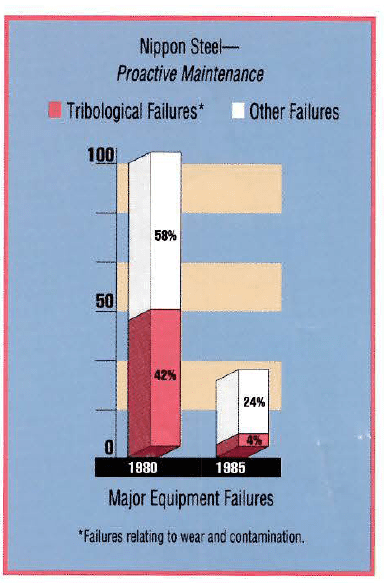
According to major industries throughout the world, it’s time to throw out your old ideas on machine maintenance. The costsaving trend is toward a maintenance program that targets the root causes of machine wear and failure. Predictive and preventive methods are out: pro-active maintenance is in. Read More
-

Proactive Maintenance–A Cost Reduction Strategy
The field of maintenance technology is going through a revolution of change. Gone are the days when a machine had a predictable service life, after which it was replaced, continuing the cycle. Today, machinery and equipment can be maintained to achieve useful operating Iives many times more attainable than just a few years ago. Read More
-
Proactive Maintenance’s Unruly Cousin
Indeed it’s hard to justify spending time and money on things that aren’t yet broken when your maintenance staff is hog-tied, fixing the things that have broken. When breakdowns occur… well, you know the drill… not much else gets done until things are up and running again. Read More
-

Reliability’s Dirty Little Secret
This was one of those defining moments. It was some surprising insight on where maintenance and reliability professionals are in the journey to lubrication excellence. Read More
-
Systems and Methods for Real-Time Condition Monitoring of Mechanical Machinery
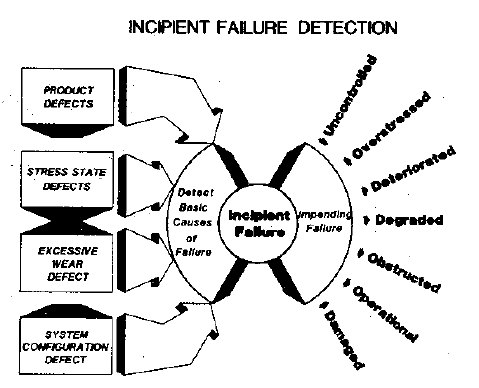
Catastrophic machinery failure in most cases can be avoided if the early symptoms are detected and appropriate action is taken. This is the essence of new condition monitoring technology which, if well conceived, can extend machine and component lives by as much as an order of magnitude. This paper discusses current condition monitoring methods including… Read More
-

Take Particle Settling and Oil Sample Agitation Seriously
When you throw a rock in a lake, it goes down – fast. Wear particles are heavier than rocks of the same size, often four to five times heavier. Of course, the heavier the object, the faster it falls. Oil is viscous, and this resistance can slow down the rate objects fall, but it doesn’t… Read More
-

The Golden Age of Lubrication
There is no greater influence on the state of lubrication than training and human behavior. I often say, “You earn what you learn.” I do not say it because it rhymes or it sounds cool. I say it because, to me, it is an unvarnished fact. Read More
-

The Greatest Racecar Driver of All Time. Mario Andretti Talks to Jim Fitch
By Jim FitchPracticing Oil Analysis Magazine It is no wonder that Mario Andretti is considered by many to be the greatest racecar driver of all time. His career touched five decades, longer than any driver, and he has won championships at all levels of competition. His list of racing accomplishments seems almost endless. It includes… Read More
-
The Hot Stove Effect in Precision Lubrication
The hot stove effect was first given to learning and management science by Mark Twain. He observed that if a cat happens to jump on a hot stove, he will never jump on a hot stove again. This of course is a good thing. However, not so good is the fact that he will not… Read More
-

The Power of 10X Cleaner…Dryer…Cooler…Better Aligned…More Training
Have you ever considered how we might be rewarded if we improved something by 10 times? For instance, what if we were 10 times richer; would we be 10 times happier? How about if we were 10 times smarter; would we be 10 times more successful? What if we worked 10 times harder? How might… Read More
-

The Power of the Patch. Comparing Particle Analysis Methods
The practice of transferring suspended particles to the surface of a membrane for analysis has been around for decades. It is perhaps the earliest method for inspecting solid contaminants and wear debris in a used sample of oil. Read More
-

The Rationale for Using Magnetic Particle Collectors
Let’s face it: Machines in industry are largely made of iron and steel. Ferrous metals both encase these machines and bear the brunt of most friction, wear and corrosion. Often, the most critical machine components, parts and surfaces are those that possess the greatest intrinsic strength and wear resistance. In more than 90 percent of… Read More
-

Using Oil Analysis to Monitor the Depletion of Defoamant Additives
The defoamant (also known as antifoam agents and foam inhibitors) is a common additive in many types of lubricating oils and hydraulic fluids. As the name implies, the purpose of the defoamant is to retard the formation of stable foam on the surface of the oil in the sump, gearbox, or reservoir. Read More