-
Execute Lubrication. When it comes to oil analysis and lubrication, execution beats brilliance.
Execution is a continuous value-building activity, beginning with perhaps a marked change in your company’s maintenance philosophy.
-
Filters can remove the water from hydraulic oil
Water in a hydraulic system constitutes a very serious form of oil contamination. Technically, water contamination is rarely recognized as such, poorly understood, and, until recently, considered difficult to combat.
-
Filters kunnen het water uit hydraulische olie verwijderen (Filters can remove the water from hydraulic oil)
Water in a hydraulic system constitutes a very serious contaminant of the oil. Nevertheless, water contamination itself is rarely recognized, poorly understood, and until recently, considered difficult to combat.
-
Ghost Riders That Haunt Your Oil

The definition of a contaminant is any foreign “something” that enters a lubricant during formulation, packaging, transport, storage or service. Contaminants compromise the lubricant’s integrity, performance and service life as well as impart harm to the machine.
-
How Dirt can Contaminate a Lubricant

Do you really know how your lubricants become contaminated? Have you taken an inventory of the sources of contamination and the primary points of entry? If not, you are in the majority as sadly, few organizations go to the trouble of performing a contaminant ingression study.
-
How Filters Work to Control Contamination in Oil

Imagine the filter inside your machine is made of fibers the size of telephone poles, stacked randomly in all directions, many layers thick. Each juncture where poles touch is a drop of super glue for support. To emulate actual operating conditions, the stack of poles is placed on a large moving and vibrating table.
-
How to Fix a Poor Maintenance Culture [in Russian]
![How to Fix a Poor Maintenance Culture [in Russian]](https://tesibis.com/wp-content/uploads/2025/12/image-159.png)
Poor maintenance performance is rarely the result of individual failure. Instead, it reflects deeper organizational and cultural issues that influence how maintenance is planned, executed, and valued. In How to Fix a Poor Maintenance Culture, Jim Fitch examines the systemic causes behind ineffective maintenance practices and explains why cultural transformation is essential for achieving reliable,…
-
How to Optimize the Effectiveness of Oil Analysis

Recently, I heard someone say that for sixty percent of heart failures, the No.1 symptom was death. Although this is an interesting and serious statistic, one has to acknowledge the possibility that certain symptoms were ignored or simply went unnoticed.
-
Increasing Demands Bring Advancements in Oil Filtration
Filtration has two primary objectives. The first objective is “protective”. This refers to creating a barrier to protect particle-sensitive machine components from the invasion of contaminants capable of causing sudden-death machine failure.
-
Oil Analysis Effectively Uncovers Hidden Problems
Oil analysis is about surfacing problems that were otherwise hidden from view. We’ve all heard the phrase “if it ain’t broke don’t fix it,” but an important corollary is “if it is broke, fix it fast.” The basic problem with this strategy is not knowing when something is actually broken.
-
Oil Analysis—Choose Your Weapon
A number of months ago I was invited to participate in a planning meeting for re-engineering oil analysis at a large industrial plant. Shortly after taking my seat, introductory remarks were made by the superintendent of maintenance to set the stage for the work ahead. To my surprise we were told to develop a strategy…
-
Proactive Maintenance Cleans Up on Predictive/Preventive Methods
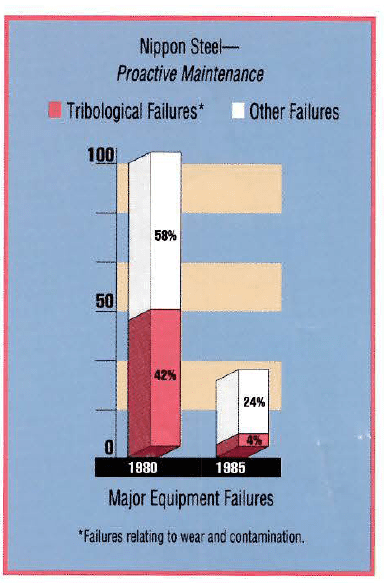
According to major industries throughout the world, it’s time to throw out your old ideas on machine maintenance. The costsaving trend is toward a maintenance program that targets the root causes of machine wear and failure. Predictive and preventive methods are out: pro-active maintenance is in.
-
Proactive Maintenance–A Cost Reduction Strategy

The field of maintenance technology is going through a revolution of change. Gone are the days when a machine had a predictable service life, after which it was replaced, continuing the cycle. Today, machinery and equipment can be maintained to achieve useful operating Iives many times more attainable than just a few years ago.
-
Proactive Maintenance’s Unruly Cousin
Indeed it’s hard to justify spending time and money on things that aren’t yet broken when your maintenance staff is hog-tied, fixing the things that have broken. When breakdowns occur… well, you know the drill… not much else gets done until things are up and running again.
-
Reliability’s Dirty Little Secret

This was one of those defining moments. It was some surprising insight on where maintenance and reliability professionals are in the journey to lubrication excellence.
-
Systems and Methods for Real-Time Condition Monitoring of Mechanical Machinery
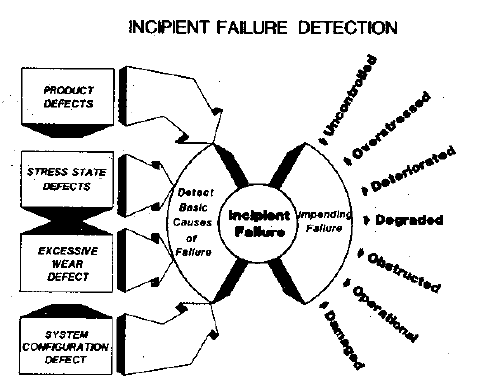
Catastrophic machinery failure in most cases can be avoided if the early symptoms are detected and appropriate action is taken. This is the essence of new condition monitoring technology which, if well conceived, can extend machine and component lives by as much as an order of magnitude. This paper discusses current condition monitoring methods including…
-
Take Particle Settling and Oil Sample Agitation Seriously

When you throw a rock in a lake, it goes down – fast. Wear particles are heavier than rocks of the same size, often four to five times heavier. Of course, the heavier the object, the faster it falls. Oil is viscous, and this resistance can slow down the rate objects fall, but it doesn’t…
-
The Golden Age of Lubrication

There is no greater influence on the state of lubrication than training and human behavior. I often say, “You earn what you learn.” I do not say it because it rhymes or it sounds cool. I say it because, to me, it is an unvarnished fact.